How a K-pop Music Show Pre-Recording Works
A pre-recording, "sanok" to fans, is the stage filmed in advance and transmitted during the live hour. Entry opens per episode. This guide sets seven episode notices from KBS, SBS, MBC and Mnet side by side and reads how the window, the capacity and the check-in are decided.
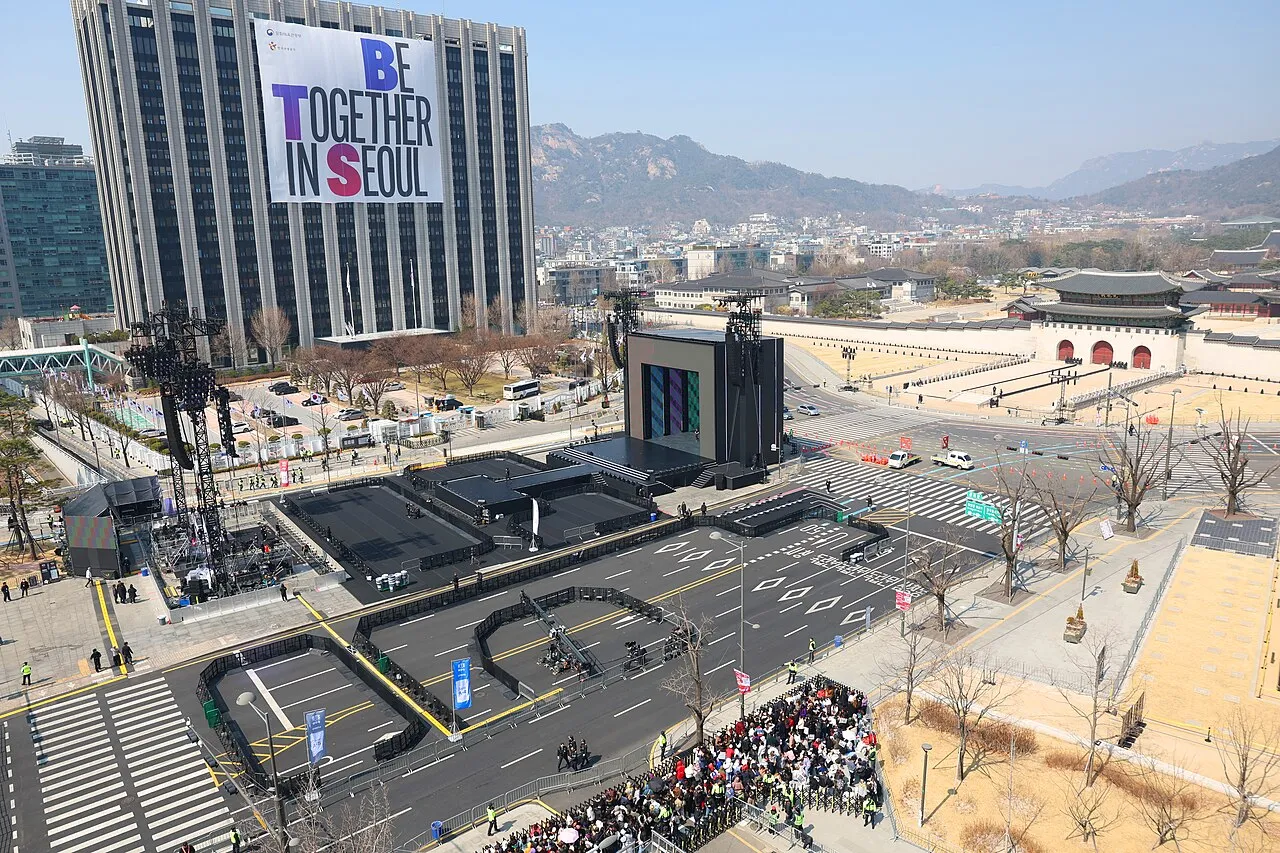
Korean music shows are mostly presented as live, but the stage that goes out on television during that hour was not always filmed then. A stage recorded in advance can be transmitted at the live time, and that is a pre-recording (사전녹화) — “sanok” in the fans’ short form.
This guide reads what a pre-recording is and how taking part in one opens and closes, as seven episode notices from four broadcasters and two press reports state it. Every figure a notice gives belongs to that episode; the next episode is set by the next notice.
1. A pre-recording is a stage filmed before the live broadcast
“Sanok” is the fans’ short form of a pre-recording (사전녹화). Sports Q described it as “a way of filming a stage in advance, for the smooth staging and transmission of a music show that is otherwise broadcast live,” and Kyunghyang Shinmun wrote that it is, literally, recording before the live broadcast.
The footage is not set aside. Sports Q wrote that the pre-recorded segment is transmitted at the time of the live broadcast. The stage a viewer sees on television during the live hour may have been filmed days or hours earlier.
2. It is filmed early because the outfit and the set change
Kyunghyang Shinmun pointed to singers who change outfits between two songs, and to sets whose mood changes with them, and wrote that pre-recording is what makes that possible. It is used, the paper wrote, when the mood or the concept of the songs differs.
The same article noted that during a live broadcast other artists are on the bill too, so it is not easy for one act to present the distinctive stage it wants in the short time available. Moving the filming off the live hour buys the room to build it.
3. A pre-recorded act still performs during the live hour
Kyunghyang Shinmun wrote that having pre-recorded does not mean an act skips the live stage. It sings and performs for the audience in the hall, the paper wrote, while what goes out on television at that same hour is the pre-recorded footage.
So one episode holds two performances, and the notices are written to match: a pre-recording section and a live-broadcast section.
4. A post-recording is filmed after the live broadcast, and it opens its own application
The counterpart term is a post-recording (사후녹화). A notice of August 2017 from YG Entertainment set the two side by side for one episode: the pre-recording call was 9:30 a.m., and the post-recording call was “after the live broadcast ends.”
The applications were not one application. A March 2013 notice from the same agency stated that the pre-recording application is run separately from the post-recording application, and that the post-recording application opens two hours after the pre-recording one. Both notices are old, and their figures belong to those episodes; what the two show together is the structure — two recordings, two separate applications.
5. The side that sets the time and the headcount is not the side that posts the notice
Two outlets have published two answers to who decides. An agency official quoted by Sports Q said the broadcaster announces the pre-recording time and the number of participants. Kyunghyang Shinmun wrote that when an audience is admitted to a pre-recording, the act’s agency and its fan club agree in advance on the entry time and the headcount.
Either way, the document a fan actually reads is the agency’s or the artist’s own notice. All seven notices cited below were posted on an agency’s or an artist’s official channel, and they are a different route from the live-broadcast audience application a broadcaster’s own site runs. What one act’s episode notices look like is set out in a guide reading seven notices from one act.
6. The application window opens per episode, and runs from ten minutes to two hours
One notice sets the window for one episode. For the KBS2 Music Bank episode of 30 May 2025 it was ten minutes, 2:00 p.m. to 2:10 p.m. the day before; for the MBC Show! Music Core episode of 15 August 2026 it was also ten minutes, 2:00 p.m. to 2:10 p.m. the day before.
Other episodes ran 30 minutes. The Mnet M Countdown episode of 5 March 2026 took applications from 6:00 p.m. to 6:30 p.m. the day before, and the SBS Inkigayo episode of 8 March 2026 from 9:30 p.m. to 10:00 p.m. two days before. The M Countdown episode of 28 May 2026 ran two hours, with the notice adding that the window may close earlier than scheduled once the first-come capacity is filled.
7. The capacity differs per episode, and reserve numbers sit beside it
Across those five episodes the capacity ran from 200 to 400. The Music Bank episode took 200, the two M Countdown episodes 210 each, the Inkigayo episode 280 and the Show! Music Core episode 400.
Some episodes carry reserve numbers as well. The M Countdown and Inkigayo notices each listed ten reserves separately, and the Show! Music Core notice said applicants beyond the capacity would be given reserve numbers.
8. The check-in is not one call but a series of numbered slots
A notice does not give one meeting time; it gives a different one for each block of numbers. The Music Bank episode called numbers 1–100 at 4:30 a.m. to 5:20 a.m. and 101–200 at 5:30 a.m. to 6:20 a.m., at the KBS annex. The M Countdown episode called 1–100 at 8:30 a.m., 101–210 at 9:40 a.m., and reserves and latecomers at 10:50 a.m., at CJ ENM in Sangam.
The Inkigayo episode split its calls at 6:00, 6:40 and 7:20 a.m. outside the SBS open hall in Deungchon-dong, and the Show! Music Core episode called blocks from 9:00 a.m. to 11:40 a.m. at the MBC open hall in Sangam before regrouping everyone at 12:20 p.m. The official quoted by Sports Q said that because the live hour is fixed, a crowded comeback week pushes recording times into the early morning or the previous late night.
9. The pre-recording list can become the order of entry for the live broadcast
The M Countdown notice for 5 March 2026 stated that live-broadcast participation takes no separate application and follows the order of the pre-recording list. The same structure appears in a notice thirteen years older: the 2013 notice stated that no separate application is taken for the live broadcast and that those with early numbers on the pre-recording list take part in it.
Not every episode works that way. The Inkigayo notice for 8 March 2026 said the live-broadcast headcount would be announced on the official account that day.
10. Eligibility, what to bring and what a no-show costs are set by that episode’s notice
The requirements differ from notice to notice. The Music Bank notice of 30 May 2025 listed, as eligibility, subscription to the official membership, purchase of three or more versions of the same album, and possession of the official light stick; the items to bring were a physical ID, a printout of a Melon download record, the mobile membership card and a working light stick. The M Countdown notice of May 2026 listed a valid ID matching the submitted name exactly. How such a list is written out is set out in a guide reading one act’s fan-club-seat requirements item by item.
No-shows are written down too. The Show! Music Core notice of August 2026 said a selected applicant who does not attend receives one blacklist warning, and that two warnings bar participation in related public broadcasts, while someone holding a reserve number is excluded from that count. The 2013 notice stated that those arriving without having applied cannot take part, and both notices set an age limit.
11. Inside, there are rehearsals and the recording itself, and filming is not allowed
Sports Q wrote that a pre-recording today builds its audience list from online applications, that fans are checked outside the broadcaster at the announced time and then queue in list order. Once inside the studio, the article said, they watch one or two rehearsals and the recording itself.
The same article wrote that photography and audio recording are prohibited inside the studio and that anyone caught filming is removed at once. It also recorded that times slip: most agencies announce a start time while stating that it may change according to the broadcaster’s circumstances.
Frequently asked questions
What is the difference between a pre-recording and a post-recording?
When it is filmed. A pre-recording is filmed before the live broadcast and that footage is transmitted during the live hour; a post-recording is filmed after the broadcast ends. A 2017 notice set the pre-recording call at 9:30 a.m. and the post-recording call at “after the live broadcast ends.” The applications open separately.
If I attend a pre-recording, do I see the live broadcast too?
That episode’s notice decides. The M Countdown notice for 5 March 2026 said live-broadcast participation takes no separate application and follows the pre-recording list order. The Inkigayo notice for 8 March 2026, by contrast, said the live-broadcast headcount would be announced on the official account that day.
Where are the application notices posted?
All seven notices read here were posted on an agency’s or an artist’s official channel. They are a different route from the live-broadcast audience application a broadcaster’s own site runs.
Why do the capacity and the required items change from episode to episode?
Because one notice sets them for one episode only. The five episodes read here had capacities of 200, 210, 210, 280 and 400, and the required items differed from notice to notice.
What time do I need to be there?
A notice gives a different time for each block of numbers. In the episodes read here the earliest was 4:30 a.m. and the latest 12:20 p.m. Sports Q wrote that most agencies announce a start time while stating that it may change according to the broadcaster’s circumstances.
Can I take photos at a pre-recording?
Sports Q wrote that photography and audio recording are prohibited inside the studio and that anyone caught filming is removed at once.
Sources
Claims in this story link to official or primary sources.
- 01
- 02
- 03
- 04
- 05
- 06
- 07
- 08
- 09
Related stories

How RESCENE's Music Show Audience Entry Opens and Closes
Applying for the studio audience at a RESCENE music show recording opens per episode: the agency publishes a notice for each programme, and it sets the application window, the number admitted, the roll-call time and the entry order for that day alone. This guide reads seven published episode notices side by side.

What a RESCENE Fan Club Seat Is Checked Against
RESCENE's fan club seats at a music show recording are checked against six items set by one notice from the agency. This guide reads that notice — the accepted ID documents, the light stick, the two opened album versions, the printed Melon receipt, the membership card and the streaming report screen.

How the other five Korean music shows score a No. 1
Show! Music Core, M COUNTDOWN, Inkigayo, Show Champion and The Show each weight their charts differently, and one of the five publishes no formula at all.
How music show voting works: Music Bank's K-Chart
KBS publishes the Music Bank formula every week: digital music 60%, broadcast plays 20%, the K-POP fan vote 10%, albums 5% and social media 5%.

BTS Win Three 2026 MTV VMAs, Including Song of the Year for 'SWIM'
BTS won Song of the Year and Best K-pop for 'SWIM' and added Best Group at the 2026 MTV Video Music Awards in Los Angeles on 27 September 2026 (local time), taking all three categories they were nominated in. The members did not attend the ceremony and sent their thanks through their agency.

BTS's 'ARIRANG' Tokyo Dome Concert Gets Its First TV Broadcast on Japan's TBS on 28 November
Japan's TBS will air the first night of BTS's 'ARIRANG' world tour at Tokyo Dome, recorded on 17 April, at 8 p.m. on 28 November on the CS channel TBS Channel 1, as the concert's first and exclusive TV broadcast. Star News reported that TBS is scheduling 28 BTS-related programmes through November.